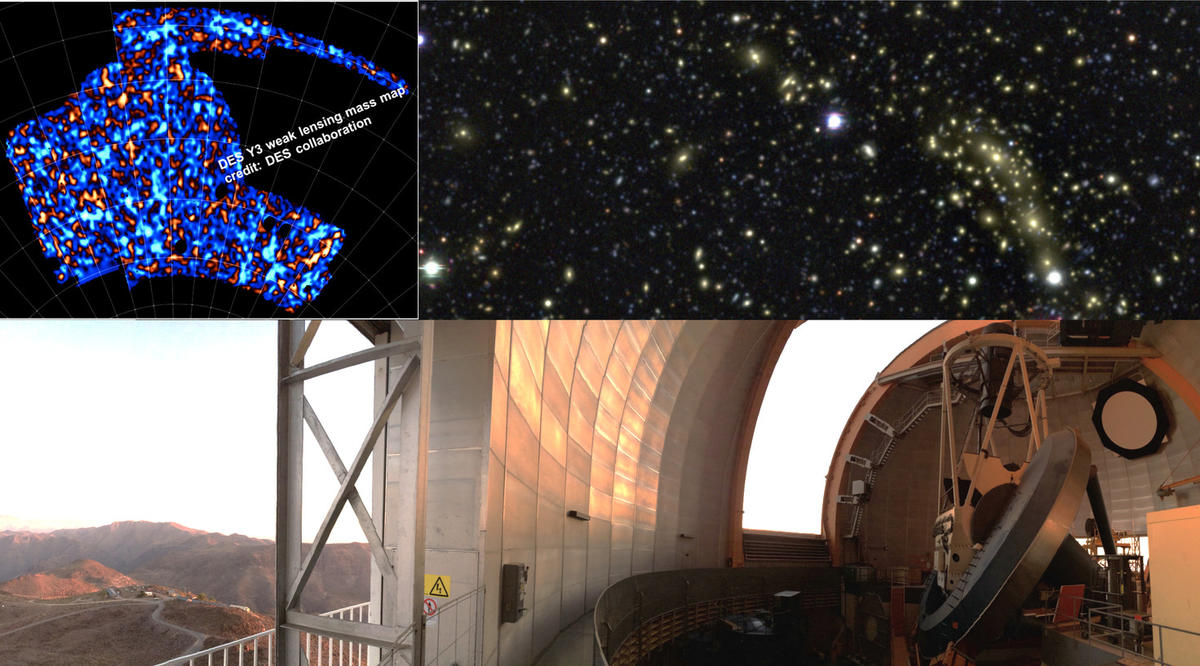
The overarching goal of our group is a model and a quantitative understanding of the cosmos as a whole and the structures that form inside of it. Our primary tool for this are photometric and spectroscopic cosmological surveys, which we use to study large structures in the Universe, such as galaxies, clusters of galaxies and even larger-scale matter density fluctuations. The census and evolution of these structures is interesting in its own right, but it can also give us a better understanding of two of the greatest mysteries of modern physics, dark matter and dark energy. To reach that goal, we need to develop new methods in statistics and data analysis, particularly artificial intelligence, for the extraction of reliable and powerful information from observations.
Our group consists of 15 researchers at all levels working on the calibration and innovative use of weak gravitational lensing measurements; the characterization of photometric and spectroscopic galaxy data, including with dedicated survey programs we lead; methods for modeling cosmological statistics of the matter and galaxy density field based on analytical calculations, simulations, and artificial intelligence; generative modeling of the galaxy and galaxy cluster population and their spectroscopic, photometric, and multi-wavelength observations; and the accurate and precise extraction of information from cosmological surveys with the help of artificial intelligence. We have relocated from Stanford University / SLAC National Accelerator Laboratory to LMU's University Observatory in 2021. We collaborate globally with observers, data scientists, and theorists from the Dark Energy Survey Collaboration, the Vera C. Rubin Legacy Survey of Space and Time, the Euclid project, the Dark Energy Spectroscopic Instrument collaboration, and 4MOST.
We invite applications from candidates with a strong track record of collaborative research in astrophysics, cosmology, and/or artificial intelligence. We are open to your own ideas that contribute to building a better model of the cosmos and connect to the existing work within our team, and also provide examples of two possible PhD topics within our group below:
- PhD topic: “A census of the galaxy population across time”
What do we talk about when we talk about galaxies? Large observational programs like the Dark Energy Survey, the Legacy Survey of Space and Time, Euclid, DESI, and 4MOST, are now and over the next decade gathering data on galaxy samples of unprecedented size. What can we learn about the true underlying distribution of galaxy properties from these photometric and spectroscopic observations? What is the statistical connection of redshifts, masses, biographies, and spectral energy distributions of galaxies? In this project, you will build upon existing artificial intelligence methodology to categorize galaxies to incorporate future survey data and extend and test the modeling of distributions and evolutions of the physical properties of galaxy samples. - PhD topic: “Non-Gaussian matter and galaxy density fluctuations”
Are the large-scale structures present in the cosmos today, and those present a few billion years ago, consistent with primordial fluctuations that grew under the laws of General Relativity in a Universe filled with mostly vacuum energy and cold dark matter? It turns out this question can be answered much more stringently if we are able to use features of density fluctuations beyond its variance alone, and combine the information from galaxy counts and gravitational lensing, for instance with statistics of their full joint PDF. In this project, you will develop techniques to measure and model these non-Gaussian density fluctuations and apply them to the latest data sets from the Dark Energy Survey, the Legacy Survey of Space and Time, Euclid, and spectroscopic surveys.