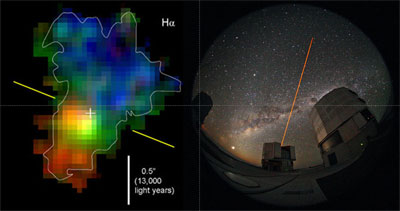
We take a unique approach in combining experimental and observational astrophysics - we focus on important astrophysical questions, and then build the best instruments to answer them! Our main science themes center on the formation and evolution of galaxies at redshifts between 1 and 3, and the physics of galactic nuclei and black holes across cosmic time. Key results have been the unambiguous detection of the supermassive black hole in the center of our Galaxy through stellar orbits and the first successful test of General Relativity in the vicinity of a supermassive black hole, the first substantial survey of high redshift galaxy dynamics using integral field spectroscopy, and the first studies of cold gas and
far-infrared luminosities of distant massive 'normal' galaxies.
These results show samples of our research on the physics and growth of black holes in galactic nuclei, especially the Galactic Center; gas dynamics in the vicinity of SMBHs; the nature and evolution of star forming galaxies at low and high redshift; and feedback processes from star formation and AGN. Within our own Galaxy, our research focusses on the physical and chemical evolution of dense gas associated with protostars and protoplanetary disks, with special emphasis on the role of water.
A key strength is that we lead world-class instrumentation developments that are driven by our astrophysical research. In the near-infrared, we have been the PIs or significantly contributed to several current instruments at the ESO VLT over the last 2 decades: SINFONI, the integral field imaging spectrometer, NACO, the diffraction limited imager, and the KMOS multi-IFU spectrograph. We were the PI Institute for the far-infrared camera/spectrometer PACS operating from 2009 to 2013 on board ESA's Herschel Space Observatory.
Currently, we are the PI-group for GRAVITY, an astrometric imager and the first second-generation instrument for the VLT interferometer. GRAVITY is now in full operation, and is a game changer for infrared interferometry, because it can routinely observe sources up to a factor 1000 more sensitive than previous interferometers. We are building GRAVITY+ which will provide further drastic improvements of sensitivity and sky coverage. Spectacular results from our team include
testing General Relativity near the Galactic Center black hole, and kinematically resolving the broad line region in nearby and distant AGN and QSOs, among other topics.
We are also the PI institute for the ERIS diffraction limited imager and spectrograph at the VLT, which is now executing our major galaxy evolution and Galactic Center observing programmes, and the first-light instrument, MICADO, for the upcoming European Extremely Large Telescope. At longer wavelengths members of our group have actively supported the upgrade of NOEMA at IRAM.
Research areas for which we offer PhD theses are:
- Unique instrumentation concepts in high resolution astronomy –
- GRAVITY+
- Exploring galaxy evolution through near-infrared to mm-wave high resolution observations of high redshift galaxies –
- NOEMA3D/ERIS
- The Black Hole in the center of our Galaxy and its surrounding stellar cluster with GRAVITY and ERIS – a laboratory for understanding black holes and strong gravity –
- Galactic Center
- Accreting black holes: resolving the broad line region and host dust distribution in active galactic nuclei
For more details visit the homepage